One of the most controversial aspects of the rapid expansion of prediction markets into professional and collegiate sports is how closely certain event contracts resemble traditional sports betting. Although prediction market operators describe their products as financial trading instruments rather than gambling opportunities, many of the outcomes available to consumers are virtually identical to those found at licensed (and unregulated) sportsbooks. Perhaps nowhere is this similarity more apparent than with prediction market point spreads, which allow participants to risk money on the margin of victory in a sporting event.
Platforms such as Kalshi have introduced sports-related event contracts that mirror familiar sportsbook offerings, including game winners, point spreads, and total points. The primary differences involve how these contracts are priced, purchased, sold, and regulated rather than the underlying sporting outcomes.
For individuals with a history of sports betting problems, or those who are increasingly drawn to speculative financial activities, this distinction is particularly important. A product marketed as trading can still expose consumers to many of the same psychological triggers, financial consequences, and behavioral patterns associated with gambling addiction.
How Point Spreads in Prediction Market Sporting Event Contracts Promote Addictive Behavior Among Vulnerable Traders
First, How Prediction Market Point Spreads Work
A point spread is designed to account for the expected difference in performance between two competing teams. Rather than simply selecting which team will win a game, participants predict whether a particular team will outperform or underperform a predetermined margin.
In traditional sports betting, a favorite might be assigned a point spread of -6.5, meaning that the team must win by at least seven points for a wager on that side to succeed. The opposing underdog, listed at +6.5, can either win the game outright or lose by six points or fewer.
Prediction market point spreads operate on essentially the same underlying principle. However, instead of placing a conventional wager at sportsbook odds, participants buy event contracts tied to specific outcomes.
For example, a prediction market might offer a contract asking whether a football team will win by more than 6.5 points. A participant can purchase a Yes contract if they believe that outcome will occur or take the opposite position.
On platforms using binary event contracts, prices generally range from $0.01 to $0.99, with winning contracts settling at $1 and losing contracts settling at zero. Trading fees may apply, and participants may be able to sell their positions before the event concludes.
Kalshi’s published football spread contract specifications confirm that its markets can be based on whether a team wins by a specified point margin.
NFL Point Spread Example: Traditional point spread versus prediction market contract
| Feature | Sportsbook | Prediction market |
| Outcome | Team covers -6.5 | Team wins by more than 6.5 |
| Position | Place a wager | Buy a Yes contract |
| Pricing | Betting odds | Contract price |
| Revenue model | Typically bookmaker margin | Trading fees and/or market spread |
| Exit before game ends | Cash-out where offered | Sell contracts where trading is available |
Note: This is an illustrative matchup, spread, and contract price, not a live Kalshi market. Further, specific settlement rules, pricing, and available features vary by operator.
NBA Point Spread Example: Los Angeles Lakers vs. Boston Celtics
The same principle applies to NBA basketball. For example, imagine the Los Angeles Lakers (LAL) are playing the Boston Celtics (BOS), with Boston favored by 5.5 points.
In a traditional sportsbook, the point spread might appear as:
- BOS -5.5: Boston must win by six or more points.
- LAL +5.5: Los Angeles can win outright or lose by five points or fewer.
On a prediction market such as Kalshi, participants could instead purchase contracts tied to whether Boston will win by more than 5.5 points.
To keep the math simple, let’s use an example of someone purchasing 100 prediction market contracts at $0.60 each, for a total investment of $60. We’re using 100 contracts simply because it makes the numbers easier to understand. Each contract pays $1 if the predicted outcome occurs, regardless of what the participant originally paid for it. In this example, the participant is predicting that the Boston Celtics will defeat the Los Angeles Lakers by at least six points. If Boston wins by six or more points, all 100 contracts pay $1 each, returning $100. Since the participant originally spent $60, their profit would be $40, before trading fees. However, if Boston wins by five points or fewer, or loses the game outright, the prediction is incorrect. The contracts become worthless, and the participant loses their entire $60 investment. This illustrates how prediction market point spreads work: participants purchase contracts at prices that reflect market expectations, with the potential to earn a profit if their prediction is correct or lose their investment if it is wrong.
Under a traditional sports betting model, let’s use the same Boston Celtics versus Los Angeles Lakers example, with Boston favored to win by 5.5 (or -5.5) points. Instead of purchasing prediction market contracts, someone places a $60 wager on the Celtics at a point spread of -5.5. For simplicity, we’ll assume the sportsbook offers odds of -110, which means a bettor must risk $110 to earn $100 in profit if their prediction is correct. The minus sign indicates that the amount required to win $100 is greater than $100. However, bettors aren’t required to wager exactly $110, as smaller or larger wagers are permitted, with potential winnings adjusted proportionally. Since our example involves a $60 wager, we calculate the potential profit by dividing $60 by 110 and multiplying by 100, resulting in approximately $54.55 in potential profit. If Boston wins by six or more points, the wager is successful, and the bettor receives their original $60 back, plus $54.55 in profit, for a total payout of $114.55. However, if Boston wins by five points or fewer, or loses the game outright, the wager is unsuccessful, and the bettor loses their entire $60 wager.
The underlying prediction is identical in both examples. The primary difference is how the potential payout is calculated. Traditional sportsbooks use betting odds, while prediction markets use contract prices that determine how much a participant pays for the opportunity to receive $1 per successful contract.
Although the pricing and transaction mechanisms differ, the underlying outcome is essentially the same as a conventional NBA point spread wager.
The distinction is meaningful from a financial and regulatory perspective. Traditional sportsbooks generally establish betting odds and incorporate a bookmaker margin, while exchange-based prediction markets rely on participants buying and selling contracts at market prices.
Nevertheless, the consumer is still risking money on whether a sporting event produces a particular result. This shared characteristic is central to the debate surrounding prediction market point spreads and gambling-related harm.
Why Prediction Market Point Spreads Are So Controversial
Prediction market operators offering sports event contracts on federally regulated exchanges generally maintain that these products fall under the jurisdiction of the Commodity Futures Trading Commission (CFTC), rather than state gambling regulators.
This classification has become a source of considerable controversy across the United States.
Traditional sportsbooks must comply with state-specific gambling laws, licensing requirements, and consumer protection standards. Depending on the jurisdiction, these obligations may include responsible gambling programs, age restrictions, self-exclusion systems, and limits on certain promotional practices.
Sports event contracts offered through federally regulated prediction markets operate under a different regulatory framework.
The disagreement is not simply about terminology. It concerns whether products that closely replicate sports betting should be subject to similar gambling-specific safeguards.
The Congressional Research Service has identified this conflict between federal derivatives oversight and state gambling authority as a significant unresolved policy issue. Courts and regulators have reached differing conclusions, while the CFTC has continued developing rules governing event contracts. Every CRS Report+2
For people concerned about prediction market addiction, the question extends beyond which government agency has regulatory authority.
If the financial risks and psychological experiences are similar, should the consumer protections also be similar?
What Can Make Prediction Market Point Spreads Addictive?
Trading prediction market point spreads involves anticipation, uncertainty, financial risk, and the possibility of monetary rewards. While these characteristics are also present in traditional sports betting, point spreads introduce additional considerations that can make participation particularly engaging and potentially harmful for individuals vulnerable to gambling-related addiction.
An important part of understanding this risk involves dopamine, a neurotransmitter (chemical messenger) in the brain that plays a central role in motivation, reward anticipation, learning, and reinforcement. Although dopamine is often called the brain’s “feel-good chemical,” its role is more complicated. Dopamine helps motivate people to pursue potential rewards, even before those rewards are received. This means that the anticipation of making a profitable prediction can become psychologically compelling, regardless of whether the individual ultimately wins or loses money.
Unlike a moneyline prediction, where the participant simply predicts which team will win, a point spread requires predicting whether a team will win or lose by a specific margin. This introduces another layer of uncertainty, as correctly predicting the winning team does not necessarily mean the point spread contract will be successful. The combination of financial risk, unpredictable outcomes, and potential rewards can engage the brain’s reward system, potentially reinforcing repeated participation.
Several characteristics of prediction market point spreads deserve particular attention:
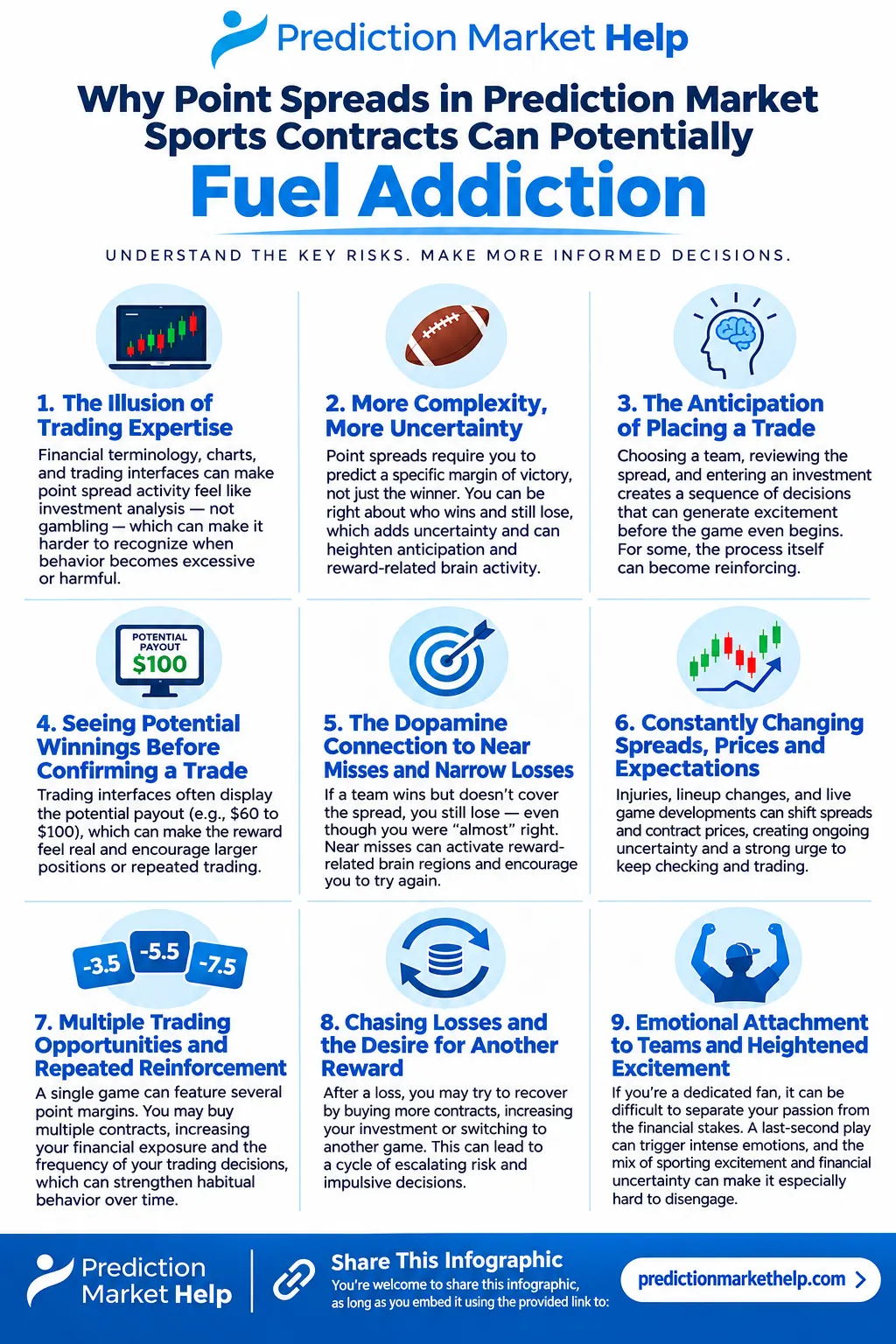
The perception of trading expertise rather than gambling. Prediction markets use financial terminology, probability charts, contract prices, and trading interfaces that resemble conventional investment platforms. Participants may begin viewing their point spread activity as financial analysis rather than sports betting, potentially making it more difficult to recognize when their behavior has become excessive or harmful. The belief that research, experience, or analytical skill can consistently produce profitable outcomes may reinforce continued participation, particularly when occasional successful predictions strengthen that belief.
Greater complexity, financial risk, and dopamine-driven anticipation. Point spreads require participants to predict a specific margin of victory rather than simply selecting the winning team. A participant can correctly predict which team wins but still lose their entire investment because the team fails to cover the spread. Although point spreads are not automatically riskier than moneyline contracts, the additional uncertainty can heighten anticipation and engage reward-related brain processes. Importantly, greater financial risk does not automatically produce greater dopamine release, but uncertainty surrounding a potential reward can make the experience particularly compelling.
The anticipation of placing a trade. Selecting a team, reviewing the point spread, choosing a contract price, and entering the amount to invest creates a sequence of decisions that can generate excitement before the sporting event even begins. Dopamine plays an important role in anticipating potential rewards, meaning the psychological excitement may begin well before the actual outcome is determined. For some individuals, the process of preparing and submitting a trade can become reinforcing in itself, encouraging repeated participation.
Seeing potential winnings before confirming a trade. Prediction market trading interfaces generally display the potential payout or profit associated with a contract before the participant completes the transaction. Seeing that a $60 investment could potentially return $100, for example, can encourage someone to imagine receiving that money. This expectation can engage reward-related motivation, making the potential payout psychologically attractive before any profit has actually been earned. For vulnerable individuals, this anticipation may contribute to larger positions or repeated trading.
The dopamine connection to near misses and narrow losses. Consider an NBA game where the Boston Celtics are favored by 5.5 points. If Boston wins by four points, someone who correctly predicted that the Celtics would win still loses their point spread position. This is commonly described as a near miss, where an unsuccessful outcome feels remarkably close to being successful. Research involving gambling has found that near misses can activate brain regions associated with reward processing and motivation, despite producing no financial reward. These experiences may encourage some individuals to try again, particularly when they believe their prediction was almost correct.
Constantly changing point spreads, contract prices, and reward expectations. Team injuries, lineup announcements, market sentiment, and developments during live sporting events can influence contract prices. These fluctuations create ongoing uncertainty about whether a participant should buy, sell, or hold a position. Because dopamine is involved in learning from unexpected outcomes and anticipating rewards, rapidly changing market conditions may encourage repeated checking and trading. For some individuals, monitoring price movements can become a compulsive activity even when they are not actively purchasing contracts.
Multiple trading opportunities and repeated reinforcement. A single football or basketball game may feature contracts involving several different point margins. Rather than making one prediction about the outcome, participants may purchase multiple contracts tied to different margins, increasing their overall financial exposure and the frequency of their trading decisions. Each new opportunity introduces another cycle of anticipation, uncertainty, and potential reward. Over time, repeated exposure to these cycles may strengthen learned associations between trading activity and the expectation of financial gains, contributing to habitual behavior.
Chasing losses and the desire to experience another reward. Someone who loses money because a team fails to cover the spread may attempt to recover those losses by purchasing additional contracts, increasing their investment, or moving to another sporting event. The motivation to recover lost money can become intertwined with the anticipation of a future reward. Dopamine-related motivational processes, combined with frustration, stress, and emotional decision-making, may contribute to continued participation despite mounting losses. This behavior becomes particularly concerning when individuals begin making increasingly impulsive financial decisions.
Emotional attachment to teams and heightened excitement. Fans who closely follow particular teams may find it difficult to separate their personal enthusiasm from the financial consequences of their predictions. A last-second basket, touchdown, or defensive play can determine whether a point spread contract succeeds or fails. These moments can produce intense emotional reactions involving several brain systems and neurochemicals, including dopamine-related reward pathways and stress-related responses involving adrenaline and cortisol. The combination of sporting excitement and financial uncertainty may make the experience especially difficult to disengage from.
Warning Signs of Prediction Market Point Spread Addiction
Problematic prediction market participation can develop gradually. What begins as an occasional interest in sports outcomes may evolve into increasingly frequent trading, larger financial commitments, and persistent preoccupation with contract prices. Warning signs resemble those associated with conventional sports betting problems, which are outlined in this PMH article.
Are Prediction Market Point Spreads More Dangerous Than Traditional Sports Betting?
There is currently insufficient research to conclude that prediction market point spreads are inherently more addictive than traditional sportsbook point spreads. The underlying financial exposure and sporting outcomes may be closely comparable, but differences in platform design, contract pricing, accessibility, and consumer protections could influence how individuals participate. For example, prediction markets may allow users to buy and sell positions before settlement, creating opportunities for repeated decisions around the same sporting event. Traditional sportsbooks, meanwhile, may offer live betting and cash-out features that generate similar patterns of engagement. The risks may therefore depend less on the platform’s formal classification and more on the combination of product design, individual vulnerability, and trading behavior.
Another consideration is the potential for prediction markets to attract consumers who would not ordinarily identify themselves as sports bettors. Someone who has previously traded stocks, cryptocurrencies, or other speculative financial products may approach sports event contracts as another form of market participation. For individuals who have experienced problems with speculative trading, this transition could introduce additional opportunities for harmful behavior.
The appropriate response is not to assume that every prediction market participant is at risk of addiction. Instead, consumers, clinicians, and policymakers should recognize that sports-related event contracts can produce gambling-like harms even when they are offered through financial trading platforms.
Getting Help for Prediction Market Point Spread Addiction
For individuals who are concerned about their participation in prediction market point spreads, seeking professional support can be an important step toward regaining control. Treatment approaches used for gambling-related problems may also be relevant to people experiencing compulsive prediction market trading, particularly when their behavior involves chasing losses, persistent preoccupation, or an inability to stop despite negative consequences.
Cognitive behavioral therapy (CBT), for example, can help individuals examine the thoughts, emotional triggers, and behavioral patterns that contribute to repeated high-risk financial decisions. Depending on individual circumstances, treatment may also address anxiety, depression, financial stress, relationship difficulties, and other concerns that accompany problematic trading. Practical measures, such as limiting access to trading platforms, establishing financial safeguards, and involving trusted family members or support professionals, may also form part of a broader recovery plan. Importantly, individuals do not need to wait until they have accumulated substantial debt or experienced a major personal crisis before seeking assistance. Early intervention can be valuable whenever trading begins to feel difficult to control.
Finding Professional Support Through Prediction Market Help
At Prediction Market Help, we recognize that the rapid expansion of sports-related event contracts is creating new challenges for consumers, families, and behavioral health professionals.
While prediction market trading differs from conventional sports betting in several important legal and operational respects, the potential for financial harm, compulsive participation, and gambling-related behavioral patterns deserves serious consideration.
Our mission is to help individuals affected by prediction market-related problems connect with qualified behavioral health professionals who understand gambling addiction, problematic financial trading, and related concerns.
Through our network of vetted treatment providers, individuals can explore appropriate support options, including virtual counseling, in-person treatment, and more intensive services when necessary.
Whether someone is struggling with prediction market point spreads, political event contracts, or other forms of speculative trading, recognizing the problem and exploring professional support can be a meaningful first step toward recovery.